


With over 26,000 sightings reported per year, bird records forms our largest recording taxon at Wharfedale Naturalists. Our reporting year runs from October to September in order to allow plenty of time to analyse the data in time for production of our annual report. We find this timeframe dovetails well with the migratory and breeding seasons of the majority of birds in Wharfedale. Please submit your records by early October.
Recording your birds
Our preference is to receive bird sightings submitted through the British Trust for Ornithology (BTO) ‘BirdTrack’ online portal), for which you will need a free MyBTO account:
After obtaining a MyBTO account, log on to the BirdTrack portal:


A BirdTrack smartphone app is also available on Google Play:
... or the iPhone App Store:
The BirdTrack app can be used for recording your sightings in the field, providing precise location information. Other recording apps exist that can be used in the field, and their data can be uploaded into BirdTrack.
Reporting via BirdTrack has significant advantages. Firstly, we are able to request details of
all sightings from the BTO from the grid squares that make up the Wharfedale recording area, with all
relevant data consolidated into one list. Secondly, it removes the need for us to report the
data onwards, as the BTO holds the national database of sightings for the BTO, RSPB,
Birdwatch Ireland, SOC and WOC (Scottish and Welsh Ornithological Club/Society). This
database is used by researchers and for planning applications nationally.
For observers not using BirdTrack or other apps, we are still happy to accept sightings shared with us. Please include the following details (preferably in this order to help us add your data efficiently):
Your Name
Species (Please use names as found in bird guides rather than colloquial names. For
example use ‘lapwing’ not ‘peewit’, ‘green plover’ or ‘tyrrfit’; ‘dunnock’ not ‘hedge
sparrow’ or ‘cuddie’. These are wonderful old names but they make it difficult to
consolidate the sightings)
Site/Location (please be as precise as possible, but don’t provide your home address, to
enable us to pin down your sighting to an Ordnance Survey grid square.
Grid Reference or Latitude/Longitude
Date
Count
Comment (where known please include detail such as sex, age, evidence of breeding, condition, evidence for
your identification if an unusual bird, etc...)
If you observe an unusual or rare bird, please provide as much detail as possible, including photos if taken, and share your sighting with the bird recorder immediately for verification purposes and to allow others to observe the bird.
Identifying birds
Nothing beats experience when it comes to identifying birds, but everyone has to start somewhere. Accompanying experienced birders is the quickest way to learn, so we heartily recommend attending Wharfedale Naturalists bird outings. However, even the most experienced of birders need to use reference material on occasion.
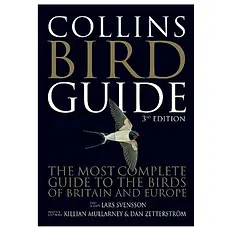
There are a large number of identification guides available, some better than others. Our favorite book is the Collins Bird Guide. It has the best text of any field guide, and plates which highlight the different plumage characteristics. It covers all European species, so may be daunting or confusing for the less experienced birder. It is also available as a smartphone app so there is no need to carry a book. There is even a version of the app that only has the British and Irish bird species. The app includes all the same descriptive text and plates and, in addition, has recordings of each birds songs and calls.
Recently several smartphone bird ID apps have become available, of which ‘Merlin’ is probably the best. Merlin’s main focus is on sound identification, by using the phone’s microphones, which many find are often more sensitive than your ears. This then couples with AI to match the song or call to Cornell University’s global library of bird sounds, making it an extremely useful app in the field. However, several species that visit Wharfedale, and have similar calls, are regularly confused by Merlin, including chiffchaff and common redstart, robin and spotted flycatcher, goldcrest and firecrest. There is also a visual identification element to Merlin, which is educational and a photo ID function. Several other apps offer these functions. However, these are even less reliable than sound ID functions. Both the visual and audio elements can also suggest rather fanciful rarities, so please check any Merlin suggestions with other reference material before reporting. Please do not submit reports of birds identified solely using Merlin or other apps; they are just not reliable enough yet.